Search is no longer just about ranking on Google.
In 2026, people discover brands through Google, AI Overviews, ChatGPT, Perplexity, Gemini, YouTube, social platforms, review sites, and answer engines. This means choosing the right SEO agency is no longer just about finding someone who can improve keyword rankings.
You need a partner who understands three layers of modern search:
SEO: Search Engine Optimization
GEO: Generative Engine Optimization
AEO / AIO: Answer Engine Optimization or AI Optimization
The names are different, but the base is still the same: users.
SEO, GEO, AEO, and AIO all work only when your content helps real people find answers, compare options, trust your brand, and take action. Google’s own SEO Starter Guide explains SEO as helping search engines understand your content and helping users find your site and decide whether they should visit it.
So, SEO is not dead. In fact, SEO is still the foundation. What has changed is the number of places where search happens.
The right agency should help your brand appear where people search, where AI tools generate answers, and where customers make decisions.
This guide will help you choose the right SEO, GEO, AEO or AIO agency in 2026, what red flags to avoid, what questions to ask, and what deliverables to expect before hiring one.
What Is the Difference Between SEO, GEO, and AEO?
Before choosing an agency, you need to understand what each term means.
SEO, or Search Engine Optimization, focuses on improving your visibility in traditional search engines like Google and Bing. This includes keyword research, technical SEO, content optimization, backlinks, site speed, internal linking, and rankings.
GEO, or Generative Engine Optimization, focuses on improving your chances of being mentioned or cited by generative AI platforms like ChatGPT, Gemini, Perplexity, and Google AI Overviews. It is less about ranking in a list and more about being trusted as a source.
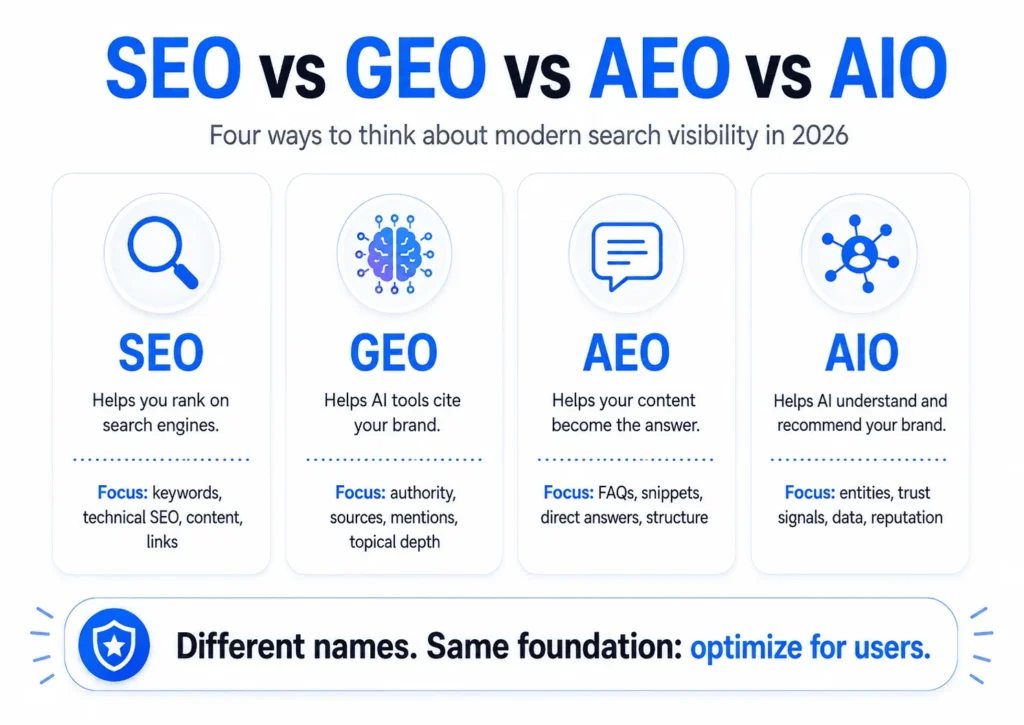
AEO, or Answer Engine Optimization, focuses on making your content easy for search engines and AI systems to use as a direct answer. This includes featured snippets, People Also Ask results, voice search answers, and AI-generated summaries.
AIO, or AI Optimization, is a broader term. It refers to optimizing your website, content, brand presence and data signals so AI-powered platforms can understand, trust and recommend your business.
In simple words:
SEO helps you rank.
GEO helps AI tools cite you.
AEO helps your content become the answer.
AIO helps AI systems understand and recommend your brand.
But all of them start from the same foundation: helpful content, technical clarity, brand trust, and user-first optimization.
A strong agency in 2026 should understand all three.
Why Choosing the Right Search Agency Matters More in 2026
Search behaviour has changed.
Earlier, users searched on Google, clicked a website and compared options manually. Today, many users get answers directly from AI tools or search result summaries without clicking multiple websites.
Google has also officially documented AI Overviews and AI Mode as part of the Search experience from a site owner’s perspective.
This creates a new challenge for businesses.
Even if your website ranks on Google, you may still lose visibility if AI tools do not mention your brand, cite your content or understand your expertise.
Zero-Click Search Is Already a Reality
SparkToro’s 2024 zero-click search study found that 58.5% of U.S. Google searches and 59.7% of EU Google searches resulted in zero clicks. This means many users either ended their session or searched again without clicking a website.
This matters because traffic is no longer the only sign of visibility.
Your brand may influence a customer even when they do not immediately visit your website.
AI Summaries Are Changing Click Behaviour
Pew Research Center found that users who encountered a Google AI summary clicked a traditional search result in 8% of visits, compared with 15% of visits when no AI summary appeared.
This does not mean SEO is dead. It means SEO has expanded.
You now need to optimize for:
- rankings
- citations
- brand mentions
- answer visibility
- entity authority
- content trust
- conversion journeys
- zero-click influence
India Makes This Even More Important
India is one of the biggest search markets in the world. DataReportal’s Digital 2026 India report says India had around 1.03 billion internet users in October 2025, with internet penetration at 70%.
IAMAI and Kantar’s Internet in India 2025 report also found that India had 958 million active internet users, with 57% from rural areas.
And while AI platforms are growing, Google is still extremely strong in India. StatCounter data for April 2026 shows Google holding 97.46% search engine market share in India.
So the right way to think about 2026 is not:
“SEO is gone. AI has replaced it.”
The better way is:
“SEO is still the foundation, but search visibility now extends into AI answers, social discovery, review platforms, YouTube, communities and answer engines.”
That is why a modern search agency should not only focus on keywords and backlinks. It should also focus on entity authority, topical depth, structured data, content quality, brand mentions, expert-led content and AI visibility tracking.
If an agency is still selling SEO like it is 2019, you may get reports, rankings and blog posts — but not real visibility in the places where customers are now searching.
What a Good SEO, GEO or AIO Agency Should Do
A strong search agency in 2026 should help you with the following areas.
1. Understand Your Business Goals First
A good agency will not start with keywords.
They will first ask:
- What does your business sell?
- Who is your ideal customer?
- Which locations do you target?
- Which services or products are most profitable?
- What does a qualified lead mean for your business?
- What is your current organic traffic and conversion rate?
- Which search platforms matter most for your audience?
If an agency starts proposing packages before understanding your business, that is a warning sign.
Search strategy should be connected to business outcomes, not just traffic.
2. Build a Search Strategy Across Google and AI Platforms
A modern agency should create a strategy that works across both traditional search and AI search.
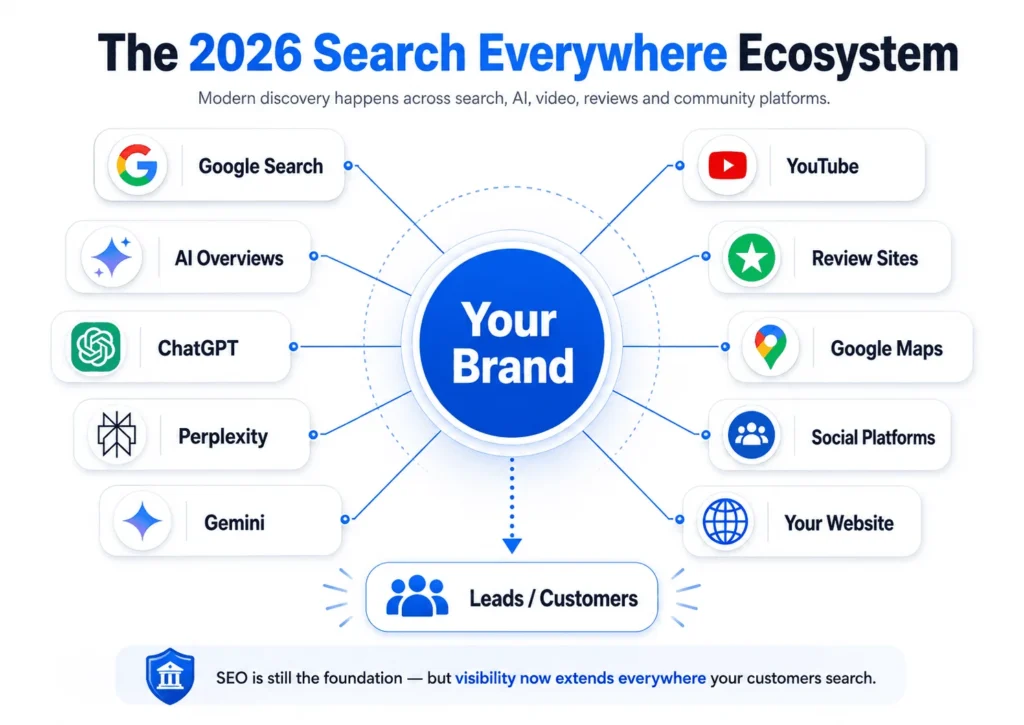
This includes:
- Technical SEO
- Content strategy
- On-page SEO
- Internal linking
- Schema markup
- Entity optimization
- Topical authority building
- Backlink and digital PR strategy
- AI search visibility tracking
- Google Search Console and GA4 tracking
- Content refreshes
- Conversion-focused landing pages
The goal is not just to publish more content. The goal is to build authority around the topics your customers care about.
3. Focus on Helpful, Trustworthy Content
In 2026, average content will not be enough.
AI tools and search engines are getting better at identifying content that is generic, copied, shallow or written only for ranking. A good agency should help you create content with real value.
This can include:
- Expert insights
- Original examples
- Case studies
- Clear definitions
- Comparison tables
- FAQs
- Process breakdowns
- Data-backed points
- Author bios
- Updated information
- Strong internal linking
- Practical takeaways
Content should not sound like it was created only to fill a keyword gap. It should help the reader make a decision.
4. Track the Right Metrics
Many agencies still report only rankings, impressions and traffic.
Those metrics are useful, but they are not enough.
In 2026, you should also track:
- Qualified organic leads
- Organic conversions
- Conversion rate from organic traffic
- Revenue influenced by organic search
- AI-referred traffic
- Brand mentions in AI tools
- AI citation frequency
- Share of voice in AI answers
- Top pages gaining or losing visibility
- Search Console query changes
- Content decay
- Featured snippet visibility
- People Also Ask visibility
The agency should explain how SEO activity connects to business growth.
If reporting is only about “we published 4 blogs and built 10 links,” that is activity reporting, not performance reporting.
Red Flags to Avoid When Choosing an SEO or AI Search Agency
1. They Guarantee Number One Rankings
No agency can guarantee number one rankings on Google.
Search engines change constantly. Competitors update their websites. Algorithms evolve. AI summaries shift based on sources and context.
If an agency promises guaranteed rankings, it usually means one of three things:
- They are targeting easy, low-value keywords.
- They are using risky tactics.
- They do not understand how modern search works.
A good agency will talk about direction, probability, strategy and measurable progress — not guarantees.
2. They Offer Very Cheap SEO Packages
SEO is not cheap when done properly.
A proper campaign needs strategy, research, technical work, content creation, reporting, optimization and ongoing improvements.
If an agency offers SEO for an extremely low monthly price, they may be cutting corners through:
- AI-generated generic blogs
- Low-quality backlinks
- Automated reports
- No real strategy
- No technical work
- No senior involvement
- Same plan for every client
Cheap SEO can become expensive later if it damages your website authority or wastes months without results.
3. They Cannot Explain Their Process
A good agency should be able to clearly explain what they will do, why they will do it and how it will help your business.
You should understand:
- What technical issues they will fix
- How they choose keywords
- How they plan content
- How they build links
- How they track performance
- How they measure AI visibility
- How they prioritize tasks
- How often they report
If their process feels like a black box, avoid them.
4. They Only Talk About Keywords
Keywords still matter, but search is bigger than keywords now.
A strong agency should also talk about:
- Search intent
- Topic clusters
- Entities
- Brand authority
- User experience
- Content depth
- Structured data
- AI citations
- Internal linking
- Conversion paths
- Digital PR
- Topical authority
If an agency only talks about ranking keywords, they may not be ready for 2026 search.
5. They Use One Strategy for Every Client
Every business is different.
An ecommerce brand, local service provider, SaaS company, education brand and healthcare business cannot use the same SEO strategy.
A good agency should customize the strategy based on:
- Business model
- Industry competition
- Website condition
- Search demand
- Content gaps
- Technical issues
- Location targeting
- Customer journey
- Sales cycle
- Budget
- Timeline
If the proposal looks like a fixed package with no real research, it is not a strategy.
Questions to Ask Before Hiring an SEO, GEO or AIO Agency
Use these questions before signing any contract.
1. How do you define success for our business?
A good answer should include leads, conversions, qualified traffic, revenue, visibility and long-term growth.
A weak answer will only mention rankings or impressions.
2. What will you do in the first 90 days?
A strong agency should explain the first phase clearly.
This may include:
- SEO audit
- Technical audit
- Keyword research
- Competitor analysis
- Content gap analysis
- Analytics review
- GSC and GA4 setup review
- Quick-win fixes
- Content strategy
- Priority page optimization
- Reporting framework
The first 90 days should not be random. It should create a strong foundation.
3. How do you approach AI search optimization?
Ask them how they improve visibility in AI Overviews, ChatGPT, Gemini and Perplexity.
They should be able to explain:
- Entity optimization
- Structured data
- Topical authority
- Expert-led content
- Source credibility
- Brand mentions
- Citation tracking
- AI visibility monitoring
- Content formatting for answer engines
If they cannot explain this clearly, they may only be rebranding traditional SEO as AI SEO.
4. Can you show real case studies?
Ask for case studies with measurable outcomes.
Good case studies should show:
- Starting point
- Problem
- Strategy
- Work completed
- Timeline
- Traffic growth
- Ranking improvement
- Lead growth
- Revenue impact
- AI visibility improvement, if available
Avoid agencies that only show vague claims like “increased visibility” without numbers or context.
5. What does your reporting include?
A good report should not be just screenshots and keyword charts.
It should include:
- What was done
- What changed
- What improved
- What declined
- Why it happened
- What will be done next
- Organic traffic
- Conversions
- Keyword movement
- Top pages
- Technical issues
- Content performance
- AI visibility metrics
- Recommendations
Reporting should help you make better decisions.
6. How do you build backlinks?
Backlinks still matter, but bad backlinks can harm your site.
Ask whether they use:
- Digital PR
- Guest contributions
- Resource link building
- Partner mentions
- Content-led outreach
- Relevant industry placements
- Local citations, if needed
Avoid agencies that buy bulk links, use spammy directories or promise hundreds of links quickly.
7. How do you use AI in your SEO process?
AI can be useful, but it should not replace strategy.
Google says appropriate use of AI or automation is not against its guidelines, as long as it is not used primarily to manipulate search rankings.
A good agency may use AI for:
- Research support
- Content briefs
- Data analysis
- Topic clustering
- Reporting assistance
- Idea generation
- Content optimization support
But human experts should review strategy, content, accuracy, tone and quality.
If the agency fully depends on AI-generated content without expert editing, that is risky.
SEO Agency Pricing in 2026
SEO pricing depends on the scope of work, competition, location, industry and business goals.
There is no single correct price.
But in India, you can generally think about SEO pricing like this:
| Monthly Budget | What It Usually Means |
|---|---|
| Below ₹15,000 | Very basic SEO, usually limited reporting, simple blogs or low-depth work |
| ₹25,000–₹50,000 | Suitable for small businesses with limited competition |
| ₹50,000–₹1.5 lakh | Better for growth-focused businesses needing technical SEO, content and optimization |
| ₹1.5 lakh–₹5 lakh | Suitable for competitive industries, ecommerce, B2B, SaaS, healthcare, finance or multi-location brands |
| ₹5 lakh+ | Enterprise SEO, large websites, digital PR, programmatic SEO, technical scale and multi-market strategy |
What Should Be Included in a Proper SEO Proposal?
A serious SEO proposal should mention:
- audit scope
- technical SEO scope
- number of pages to optimize
- content creation plan
- content refresh plan
- internal linking plan
- backlink or digital PR approach
- analytics and tracking setup
- reporting format
- communication cadence
- timelines
- responsibilities from client side
- tools required
- expected milestones
- success metrics
If the proposal only says:
“10 keywords + 4 blogs + 20 backlinks”
that is not enough for 2026.
That is a task list, not a growth strategy
How to Compare SEO Agencies Before Hiring
Do not compare agencies only by price.
Compare them by strategy quality.
Use this table:
| Evaluation Area | Weak Agency | Strong Agency |
|---|---|---|
| Discovery | Sends package immediately | Understands business, audience and goals |
| Strategy | Same plan for all clients | Custom roadmap based on market and website |
| Content | Generic blogs | Expert-led, useful, decision-making content |
| Technical SEO | Basic checklist | Deep crawl, indexation, speed and schema review |
| Reporting | Rankings and screenshots | Leads, conversions, pages, queries and insights |
| AI Search | Uses buzzwords | Explains entity, citations, answers and trust |
| Backlinks | Bulk links | Relevant digital PR and authority building |
| Communication | Monthly report only | Clear priorities and regular updates |
| Success | Traffic only | Business growth and qualified visibility |
SEO Is Still Strong – But It Must Be User-First
There is a lot of confusion around SEO in 2026.
Some people say SEO is dead.
Some say GEO has replaced SEO.
Some say AEO is the future.
Some say AI will remove the need for websites.
The truth is simpler.
SEO is still strong because people still search. Google is still dominant in many markets, including India. But the way people search has expanded.
They search on Google.
They ask ChatGPT.
They compare on YouTube.
They check Reddit.
They read reviews.
They ask Perplexity.
They look at Google Maps.
They follow creators.
They trust communities.
So the job of a modern search agency is not just to rank pages.
The job is to make your brand discoverable, understandable, trustworthy and useful across the full search journey.
The terms may change.
SEO. GEO. AEO. AIO.
But the base remains the same:
Optimize for users. Help them find clear answers. Build trust. Make decisions easier.
That is what search engines want.
That is what AI tools need.
That is what customers remember.
Final Checklist Before Choosing an SEO, GEO or AIO Agency
Before hiring an agency, check if they can answer yes to these questions:
- Do they understand your business model?
- Do they ask about leads, revenue and conversion?
- Do they audit before recommending?
- Do they understand technical SEO?
- Do they know how to improve content quality?
- Do they understand AI Overviews and answer engines?
- Do they explain GEO, AEO and AIO without buzzwords?
- Do they create people-first content?
- Do they report business outcomes, not only rankings?
- Do they avoid guaranteed ranking promises?
- Do they have real case studies?
- Do they explain their backlink strategy clearly?
- Do they customize the strategy for your industry?
- Do they understand local, national or global search requirements?
- Do they provide a clear first 90-day roadmap?
- Do they focus on long-term search equity?
If the answer is yes, they may be worth considering.
If most answers are no, keep looking.
Choose the Agency That Understands Search Everywhere
The best SEO agency in 2026 is not the one that promises first-page rankings.
It is the one that understands how people search today.
Your customers may discover you through Google, AI Overviews, ChatGPT, Perplexity, Gemini, YouTube, social platforms, review sites, Google Maps and answer engines.
So your agency should not only chase keywords.
They should help your brand become visible, trusted and useful across every major discovery point.
SEO still matters.
But modern SEO is no longer just about search engines.
It is about users.
It is about trust.
It is about answers.
It is about being found wherever your customers are looking.
Choose an agency that understands that.