
86% More Organic Users in 4 Months – For a Healthcare E-commerce Brand
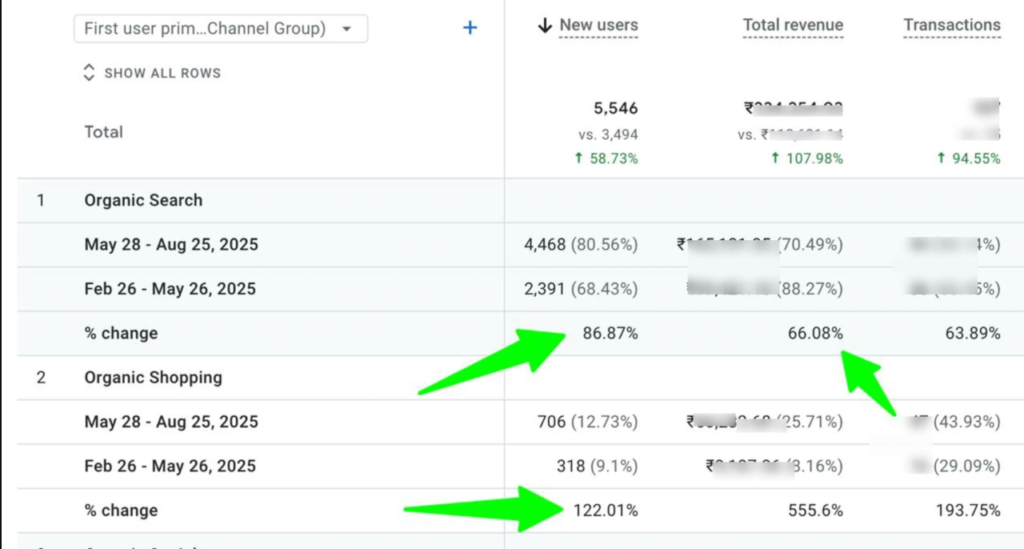
Four months after onboarding, organic users were up 86% and revenue from SEO up 66% – not from zero, and in one of the harder niches in search: healthcare products, where Google holds every page to its strictest standards. The real story is what we fixed alongside the SEO: inventory flow, the e-commerce process, and the website itself.
+86% organic users in 4 months
+66% revenue from organic search
+555% Organic Shopping revenue
- Duration: 4 months from onboarding
- Market: Pan-India
- Industry: Medical supplies e-commerce
About the Client
A medical supplies e-commerce brand serving customers across India – a catalogue of clinical and healthcare products bought by both professionals and everyday buyers. Healthcare is a YMYL (Your Money or Your Life) category: Google applies its highest bar for accuracy, trust, and expertise before letting a site rank, because the stakes for the searcher are real. Thin content and shortcut tactics don’t just underperform in this niche; they get filtered out.
When the brand came to us, their online presence was struggling. The store worked and organic traffic existed — but growth had stalled well below potential, and the reasons weren’t all inside Google.
The Problem
The audit found problems on both sides of the business:
- Organic growth had flatlined despite an existing traffic base – the site wasn’t competing for the high-intent searches where buyers actually decide
- Inventory data lagged behind the live site – products showed as available when they weren’t, creating dead ends for customers and untrustworthy data for Google Shopping
- The e-commerce journey had friction between landing and checkout, suppressing conversion from every channel
- The website needed structural work before it could support the catalogue properly
Most SEO agencies politely ignore half that list – because inventory and checkout are “not SEO.” We don’t work that way. A ranking brings the visitor; if the stock is wrong and the checkout fights them, the ranking was wasted. SEO can’t outrank operational problems. So we built a plan that went beyond keywords.
Our Approach
High-Intent Keyword Targeting + Technical SEO
The organic core ran from day one: keyword and intent mapping across the catalogue, focused on high-intent, buying-stage queries — the searches people make when they’re ready to purchase, not just researching. This was backed by technical SEO and structured data throughout, built to YMYL standards: accurate product information, clear trust signals, clean crawlable architecture.
The result went beyond classic rankings – the brand now ranks for many high-intent keywords in search and in AI answers too, visible where Indian buyers increasingly ask first.
Organising the Internal Inventory Flow
We helped the client reorganise how inventory data moved from operations to the live site, so availability started matching reality. Customers stopped hitting dead ends – and Google Shopping began receiving accurate, trustworthy product data. For a healthcare store, this is doubly important: availability accuracy is a trust signal to both the customer and the algorithm.
Streamlining the E-commerce Process
Friction between landing and checkout was identified and reduced. This multiplied the value of every visitor from every channel — the same traffic began converting better before the traffic growth even arrived.
Revamping the Website With Detailed Recommendations
We delivered structural and UX recommendations for the site revamp, implemented alongside the SEO work — so the improved architecture and the improved optimisation launched as one system instead of fighting each other.
Results
Comparing the first four months after onboarding (May 28 – Aug 25, 2025) against the previous period (Feb 26 – May 26, 2025):
Organic Search:
- 4,468 new users, up from 2,391 (+86.87%)
- +66.08% revenue from organic search — growth on an existing base, not from zero
- +63.89% transactions from organic search
- Organic search now drives 80.56% of all new users, up from 68.43%
Organic Shopping — a channel effectively unlocked:
- +122% new users (318 → 706)
- +555.6% revenue
- +193.75% transactions — nearly tripled
Across the whole site:
- Total new users up 58.73% (3,494 → 5,546)
- Total revenue up 107.98%
- Total transactions up 94.55%
The Organic Shopping numbers deserve the highlight. That channel barely functioned before, because Shopping runs on accurate product data — and the inventory flow couldn’t provide it. One operational fix, paired with structured data, opened an entire acquisition channel: 5.5x the revenue in four months.
And the site-wide picture tells its own story: organic work drove the majority of a 108% total revenue increase. When the organic engine is your biggest channel and it doubles its output, the whole business feels it.
On the “SEO Takes 6–12 Months” Belief
Many people believe every SEO project takes 6 to 12 months to show results — especially in YMYL niches, where trust supposedly takes years to build. The truth is simpler: every business and every website is different. Quick wins matter — they build momentum, they fund belief in the long game, and the long game compounds when the small wins start early. This engagement showed meaningful revenue movement inside four months, in a healthcare category, and it’s still climbing. That’s how you build momentum. That’s how you scale.
Key Takeaways
- Go beyond keywords. Fixing inventory, checkout, and site structure multiplied every ranking gain — the site, the stock, and the search strategy are one system.
- In YMYL niches, operational accuracy is SEO. Correct availability and trustworthy product data are trust signals to customers and algorithms alike.
- Organic Shopping is the most underused channel in e-commerce — accurate inventory plus structured markup turned it from dormant to +555% revenue in four months.
- High-intent targeting pays twice now: rankings in classic search and visibility in AI answers, where buyers increasingly ask first.
- Quick wins aren’t the opposite of the long game. They’re what makes the long game compound sooner.